
- Automation Cloud and Test Cloud
- Automation Cloud Public Sector and Test Cloud Public Sector
- Automation Cloud Dedicated
October 2026
October 2026 release notes for Orchestrator in Automation Cloud Public Sector.
October 28, 2026
New Orchestrator layout
We are introducing a new, redesigned layout for Orchestrator. The new layout groups pages by the task you are performing, keeps the current folder always in view, and brings folder resources and creation actions together in one place.
The new layout is not enforced. The classic layout remains available, and you can switch between the two layouts at any time.
Try the new layout
To switch to the new layout, select Try new layout in the Orchestrator header. The option is available to all users.
Folder context
The folder tree moved to the top of the sidebar, below the search field, so switching folders is always at hand.
- The Folders tree lists all folders you have access to. Select All folders to view content aggregated across the tenant and its folders.
- You can search the tree, or collapse it to a compact folder card that shows the folder you are working in.
- Hover over a folder to display its three-dot menu, which gives you quick access to folder actions, such as Copy folder path, Start job, Create subfolder, Edit, and Move.
Task-based navigation
Pages are now grouped by what you are doing, instead of one long row of tabs. Each group contains the related pages as tabs.
- Overview: health, inventory, and recent activity for the selected scope, including the Processes, Resources, Latest jobs, and Deployments overview cards.
- Monitoring: agents, machines, processes, queues, and SLA monitoring.
- Executions: Jobs, Logs, and Review requests.
- Deployments registry: Solution deployments, Processes, and Resources. This is the former Registry.
- Testing: Test sets, Test cases, Test executions, and Test data queues. Available when a specific folder is selected.
Tenant-level pages are grouped in the Tenant section at the bottom of the sidebar:
- Access: Folder management, Access rules, Roles, and Audit.
- Infrastructure: Machines, Robots, Credentials, and License.
- Feeds: solution packages, solution projects, packages, libraries, apps, tests, and feeds.
- General settings: all tenant settings tabs, such as General, Robot security, and Deployment.
All resources in one place
Folder resources such as queues, assets, triggers, storage buckets, connections, indexes, and MCP servers are now available on a single page, under Deployments registry → Resources. Use the type filters at the top of the page to show only the resources you need.
Webhooks are now also available on this page, under Deployments registry → Resources → Webhooks, when All folders is selected.
Create new menu
Hover over All folders in the folder tree and select the three-dot menu button to open the Create new menu. When the folder tree is collapsed, select the All folders card instead. From here, you can create the following entities without leaving your current page:
- Solution deployments, packages, and libraries
- Access rules for users, robot accounts, groups, and external apps
- Tenant roles and folder roles
- Machine templates, elastic robot pools, and cloud robots
- Credential stores and credential proxies
- Webhooks
The menu also includes Unattended setup and My Reports.
Quick actions in the page header
The Overview page header gives you quick actions for the selected scope:
- With All folders selected, use Add to create packages, libraries, access rules, roles, machines, credential stores, and webhooks, or Deploy to deploy a solution.
- With a specific folder selected, use Add to add processes, apps, triggers, queues, assets, storage buckets, MCP servers, and more to the folder. The header also includes Start job and Deploy.
Collapsible sidebar
Collapse the sidebar to a compact icon rail to get more space for your work. Everything stays one click away, and you can expand the sidebar again at any time.

Switch back anytime
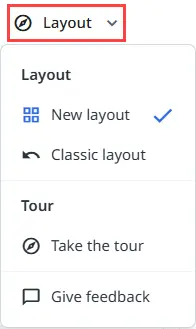
Open the Layout menu in the header to switch back to the classic layout at any time. From the same menu, you can also select Take the tour for a guided tour of the new layout, or Give feedback to tell us about your experience.
For more information, check the About the new Orchestrator layout and New layout navigation map pages.
Topology view for solution deployments
Correction, November 9, 2026: We added this entry after the release.
In the new Orchestrator layout, you can view a solution deployment as an interactive topology chart. The chart shows the resources the deployment contains, what they bind to, and the resources they share. To open it, select View in topology in the Resources tab of the deployment side panel.
For details, see About the new Orchestrator layout.
Bulk actions run on eligible rows in mixed selections
Bulk actions in Orchestrator grids are no longer disabled when your selection includes rows they don't apply to. As long as at least one selected row is eligible, the action stays available, runs only on the eligible rows, and tells you how many rows it skipped. This applies to the following actions:
- Remove for queue transactions, skipping items that are already deleted.
- Cancel and Terminate for jobs, skipping jobs that can no longer be stopped.
- Enable and Disable for time, form, HTTP, and event triggers and for test schedules, skipping entries already in the requested state.
- Delete for assets, users, and roles, skipping entries that can't be deleted, such as static roles.
- Unassign for folder machines, skipping inherited machines.
An action is disabled only when none of the selected rows are eligible.
Deleting video recordings requires View permission on the job or queue
Deleting a video recording now requires View permission on the job or queue the recording belongs to, instead of Delete, together with Delete permission on Execution Media. You can now build a role that reviews and deletes recordings without also letting it delete jobs or queue items.
Custom roles that have Delete but not View on jobs or queues can no longer delete recordings. The change also applies to the API:
DELETE /api/VideoRecording/jobs/{jobKey}requiresJobs.ViewandExecutionMedia.Delete.DELETE /api/VideoRecording/QueueItems/{queueItemId}requiresQueues.ViewandExecutionMedia.Delete.
For details, see About recording and Video recordings requests.
Personal Workspace changes recorded in audit logs
Orchestrator now records an audit entry when a Personal Workspace is created, activated, or deactivated as a result of a directory or privilege change. For example, an entry is recorded when an administrator turns a user's personal automation setup on or off, or when directory provisioning deactivates a user. Previously, only the triggering change was audited.
For details, see About audit.
JSON assets
This feature was released on October 28, 2026, but was not announced at the time. It was added to these release notes on November 3, 2026.
You can now create assets of type JSON to store structured JSON data that robots can retrieve and use during execution. When you create a JSON asset, you choose the type of data it holds, such as an object with properties defined in a schema, or an array of strings.
For details, see About assets.
Redesigned asset form
The form for adding and editing assets has a new design. The same form also opens when you create an asset from the asset suggestions or from the package requirements grid.
- The Details section groups the asset name, description, type, access, labels, and properties. For Object JSON assets, a Schema section lets you define the object properties.
- The Access scope options are replaced by the Expose value to API toggle. Automations can always read the asset. With the toggle on, external apps and integrations can also read the value through the Orchestrator API.
- The global value and the overrides are listed in the Global value & overrides grid, where you can search, page through, and remove multiple values at once. You edit the global value or an override in a side panel.
- An override, added with Add override, can target a user assigned to the current folder or a user from the identity directory, and optionally a specific machine.
- When you add or edit an override, the Account dropdown shows an icon for each account type: user, robot account, or external application. The same icons replace the initials in the grid, which falls back to initials when the account type can't be determined.
- The form displays a message when no credential store is available, or when the credential stores fail to load.
The asset side panel also uses the term account instead of robot, and shows the scope of per-account values as Per account instead of Per robot.
For details, see About assets.
Trace ID for credential store failures
When a robot fails to fetch credentials from a credential store, Orchestrator now logs the trace ID of the failed request and includes it in the job fault details. This applies to all credential stores, including the Orchestrator Credentials Proxy. Use this ID to find the exact request that failed when troubleshooting.
For details, see Integrating credential stores.
Maestro Flow node jobs run under one identity
When a Maestro Flow process runs, Orchestrator starts a separate job for each node in the flow. Node jobs that don't specify a robot now run under the caller's identity, so all the node jobs of a flow use the same identity. Previously, the identity was resolved separately for each node, so nodes of the same flow could run under different identities.
A robot explicitly selected for a node still takes precedence. The change applies only to the first-level nodes of a flow.
Apps processes renamed to Code-behind
Processes of type Apps are now called Code-behind. The new name appears wherever Orchestrator shows this process type, for example:
- The Type filter on the Processes page, under Automations.
- The folder homepage, where the Apps widget is now called Code-behind.
Bug fixes
- We fixed an issue where long-running workflows started from UiPath Assistant by a user with a developer license, such as Automation Developer, never resumed on tenants using the Unified Pricing licensing model. Resumed jobs now run on robots with a Testing or Unattended license. The fix doesn't apply to serverless robots.
October 12, 2026
Configure environment variables for RPA processes
You can now specify environment variables when deploying or editing an RPA (standard) process, using the same Environment Configuration field already available for agent processes. Enter a value directly, or reference a secret-type asset in the same folder to avoid storing the value in the field itself.
This requires Robot 25.10 or later, since earlier Robot versions don't read the environment configuration for RPA processes.
Environment variables configured this way are also captured when you export the process into an Automation Solutions package, so the values carry through install and upgrade. For details, see Managing Processes.
Batched delivery for the queueItem.added webhook event
When adding queue items in bulk, Orchestrator may now emit multiple queueItem.added events, each covering a subset of the uploaded items, instead of a single event containing all of them. Batching applies only to larger uploads.
Bug fixes
- We fixed an issue where Job Details did not show the specific app or the username of the person who triggered a job started through UiPath Apps. The Source field now displays this information for jobs started via Apps.
- October 28, 2026
- New Orchestrator layout
- Topology view for solution deployments
- Bulk actions run on eligible rows in mixed selections
- Deleting video recordings requires View permission on the job or queue
- Personal Workspace changes recorded in audit logs
- JSON assets
- Redesigned asset form
- Trace ID for credential store failures
- Maestro Flow node jobs run under one identity
- Apps processes renamed to Code-behind
- Bug fixes
- October 12, 2026
- Configure environment variables for RPA processes
- Batched delivery for the queueItem.added webhook event
- Bug fixes